Ships, not sprints: building ai-generated admin panels for a fraction of the cost
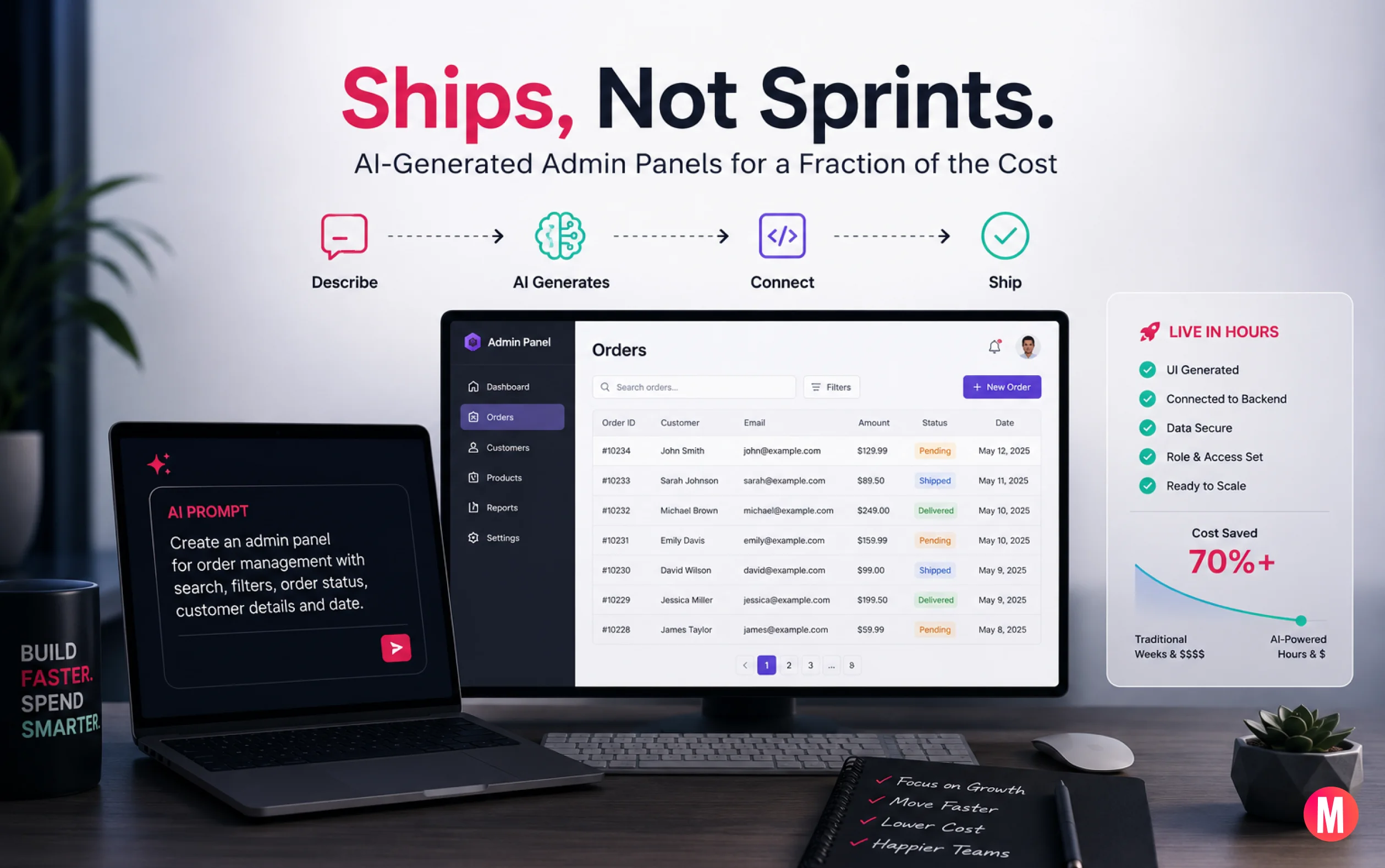
Every founder hits this wall eventually. Sales wants a lead form. Ops wants an order dashboard. Someone wants to stop pinging engineering every time a customer's email needs updating. None of it is hard, technically. It still takes two weeks and a few thousand dollars, because "simple internal tool" has a way of turning into a real project the moment a developer actually sits down to build it.
Here's the thing that makes it worse: these requests never stop coming. You ship one admin panel and three more get requested within the month. Support wants a refund-tracking screen. Marketing wants a way to manage campaign assets without emailing spreadsheets back and forth. Finance wants to see subscription churn without asking an engineer to write a query every Friday. Each one feels small in isolation. Stacked together, they quietly become one of the largest invisible line items in an early-stage budget.
The internal tool tax
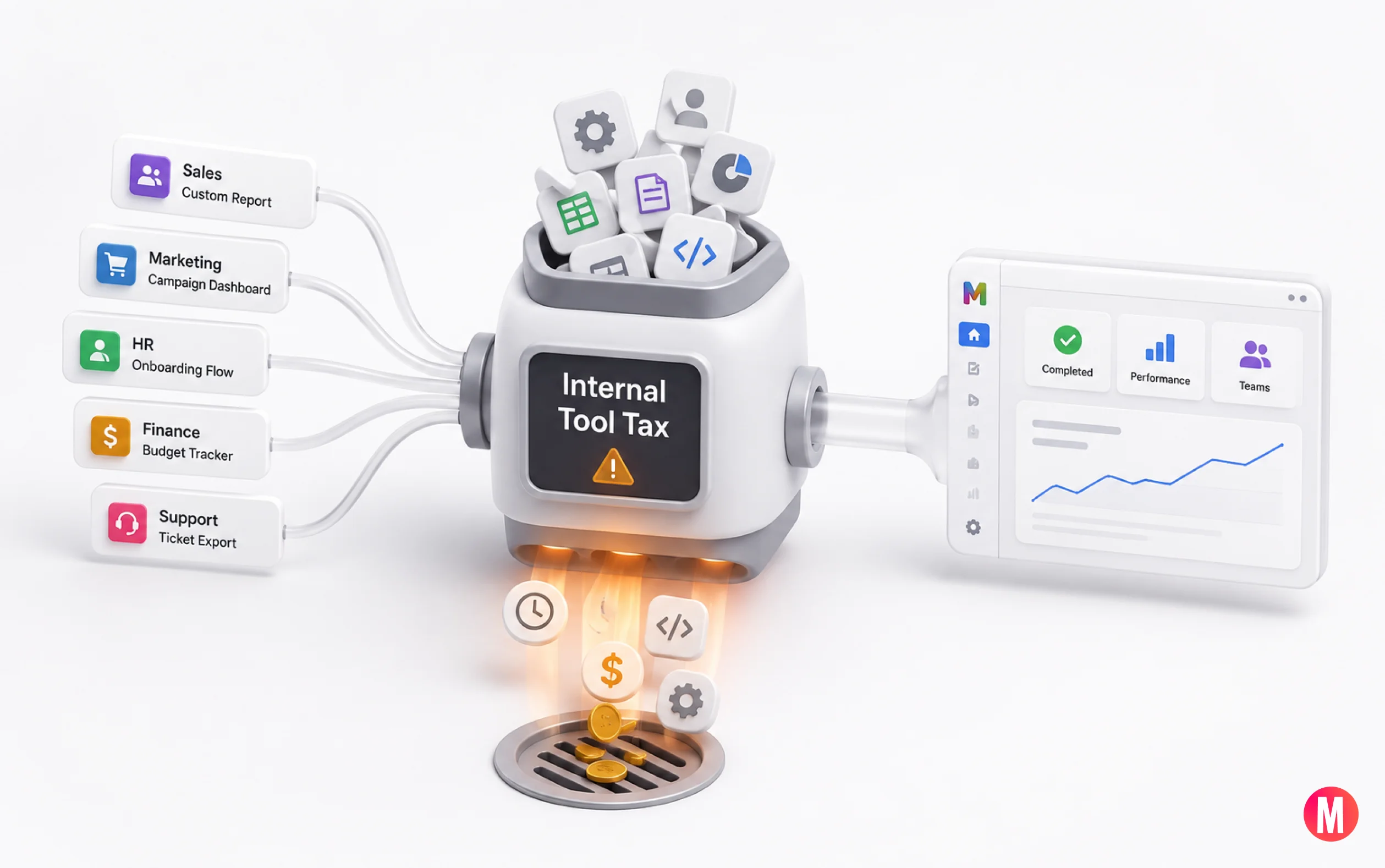
Early-stage startups burn through a strange amount of capital on tools nobody outside the company will ever see. A backoffice form. An internal order tracker. A panel so support can update a customer record without filing a ticket with engineering. None of it is customer-facing. None of it generates revenue directly. And yet it consistently eats more engineering time than anyone budgets for.
Run the actual math. A developer at $75 an hour spending two weeks on a basic admin panel runs about $6,000 — and that estimate is generous. It assumes the requirements were clear from the start, which they almost never are. Add design time for the UI, a round of QA, and the inevitable "actually, can it also follow-up request, and you're closer to $8,000-$10,000 per tool once it's actually usable.
Now multiply that by how many of these a growing company needs in a year. Sales needs a lead tracker. Ops needs an order dashboard. Support needs a customer lookup tool. Finance needs a reporting view. None of these are optional once the team scales past a handful of people, and none of them were in anyone's original product roadmap. You're not spending engineering time to build your product faster — you're spending it to keep the lights on internally.
The deeper cost isn't even the dollar figure. It's opportunity cost. Every sprint cycle absorbed by an internal tool is a sprint cycle not spent on the feature that actually moves your retention or conversion numbers. Engineers know this too, which is usually why these requests sit in a backlog for weeks before anyone touches them — nobody wants to be the person who spent two sprints on an internal dashboard while a customer-facing bug sat untouched.
The lean stack blueprint
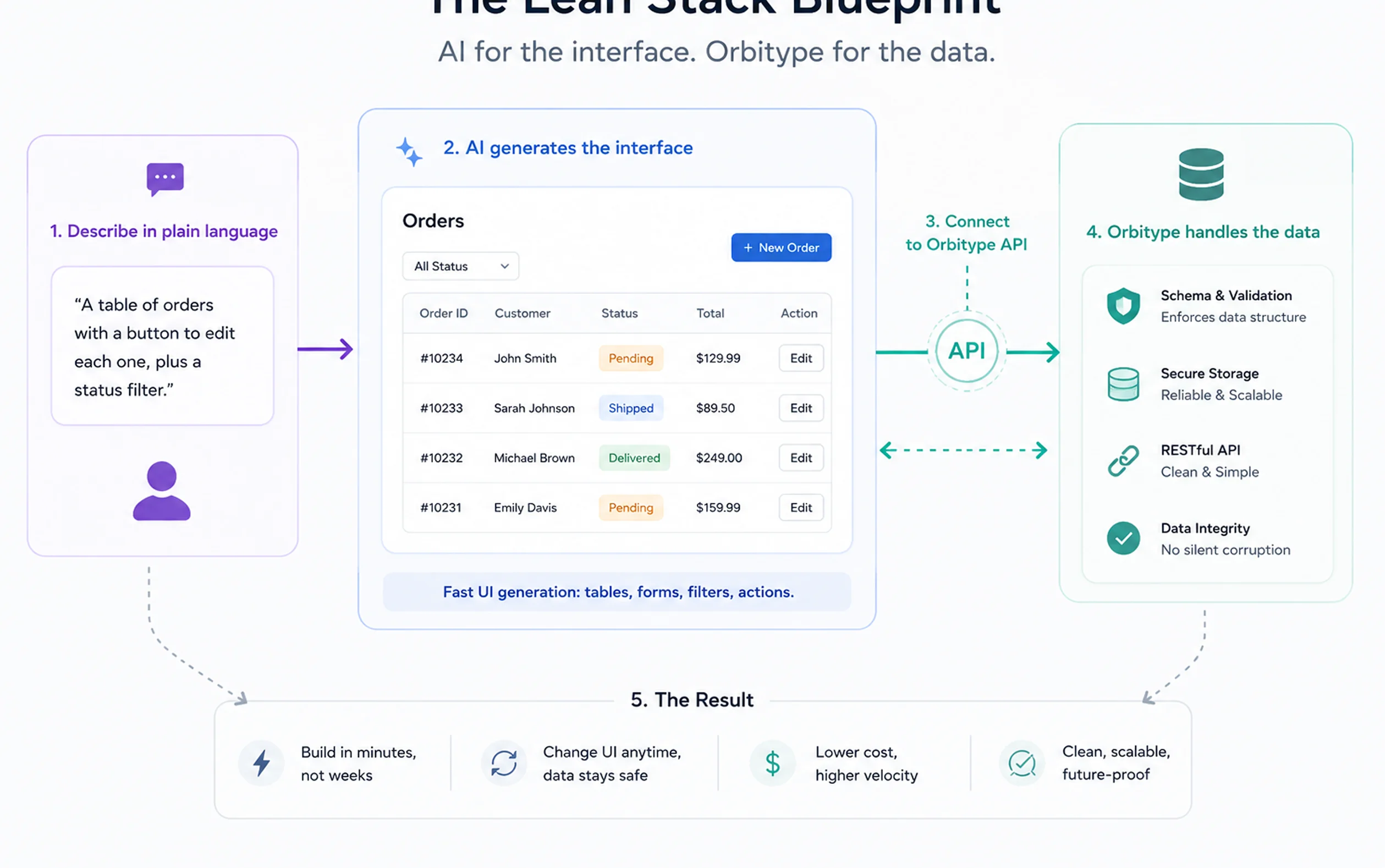
The fix is pairing two things that weren't really built to talk to each other until recently: AI interface generators and a flexible, decoupled data layer.
Tools like Claude Artifacts or Vercel v0 are good at exactly one thing in this context, and they're very good at it: turning a plain-language description into a working, reasonably polished UI. "A table of orders with a button to edit each one, plus a status filter" is enough to get something usable in under a minute, with zero designer involvement and zero CSS written by a human.
But a generated UI, on its own, doesn't store anything. It has no concept of a database, no schema validation, no persistence layer. Ask v0 to build you a form and it'll happily build one that submits to nowhere. That's the missing half, and it's where Orbitype's API comes in — a decoupled data layer that sits behind whatever interface you generate, handling the part AI interface tools were never designed to handle.
You define your schema once: customer name, email, order total, status, whatever fits your case. Orbitype enforces that structure on every record going forward, so a malformed submission doesn't quietly corrupt your data three weeks later when nobody's looking. The AI handles the part it's actually good at — the visual layer, the interaction design, the responsive behavior. Orbitype handles the part it's built for — storage, validation,and the API surface that ties records together. Neither one needs to know much about the other beyond thecontract between them: field names, types, and an endpoint.
This separation is the actual unlock here, more than the AI generation itself. Decoupling the interface from the data means you can regenerate or redesign the UI at any point — swap v0 for a different tool, ask for a dark mode version, rebuild it entirely in six months — without touching a single record in your database. Try doing that with a traditionally coded internal tool and you're looking at a migration project.
Rapid Prototyping in Action
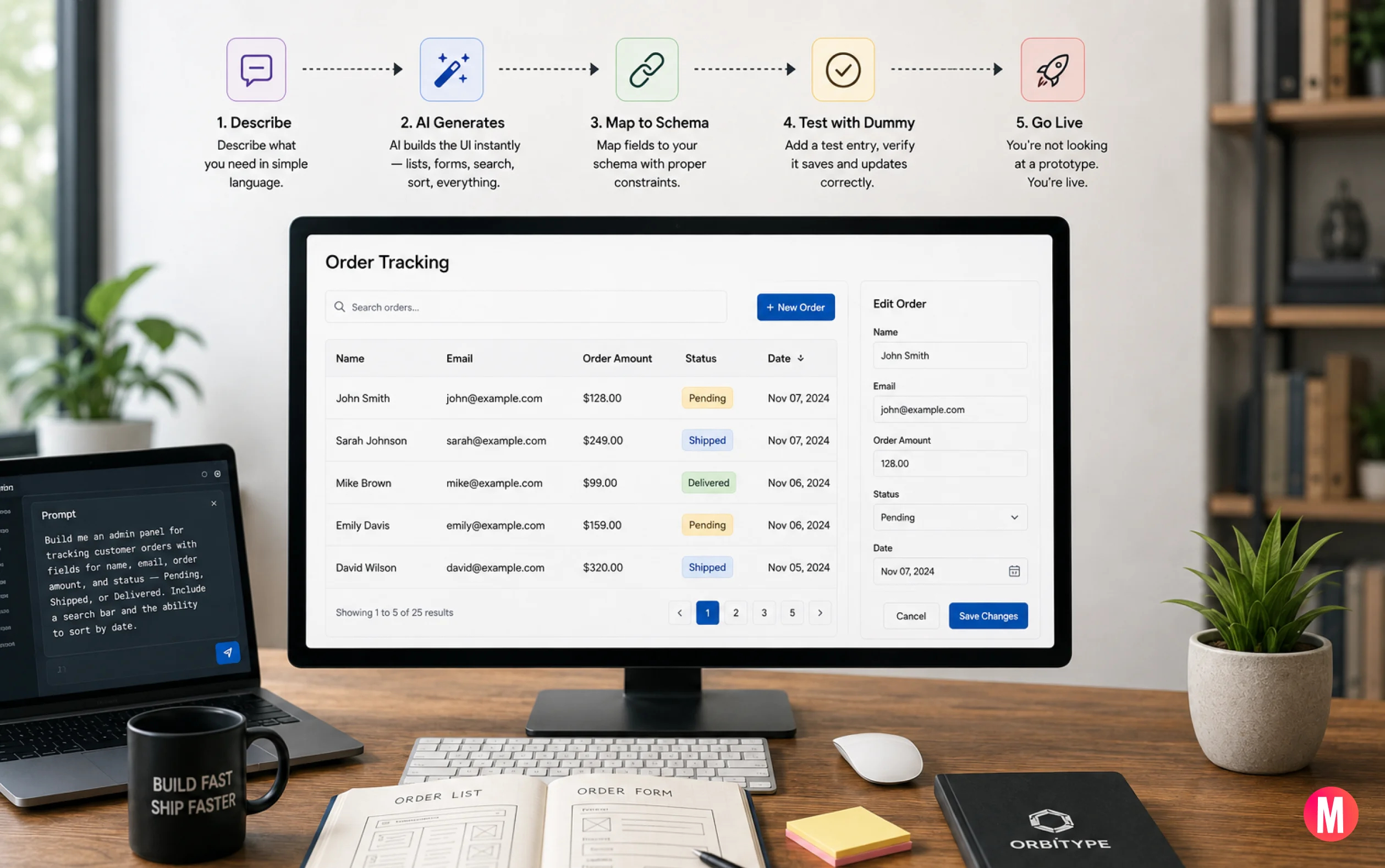
Here's what that looks like in practice, end to end, using a concrete example: an order-tracking panel for a small e-commerce operation.
Start with the description: "Build me an admin panel for tracking customer orders with fields for name, email, order amount, and status — Pending, Shipped, or Delivered. Include a search bar and the ability to sort by date." Feed that to Claude or v0. Within seconds you'll have a record list, a working search input, sortable columns, and an edit form, styled and responsive, with none of it hand-coded.
From there, map the fields the AI generated straight onto your Orbitype schema. Name maps to name, email maps to email, status maps to a constrained field with three allowed values instead of free text — that
constraint matters, because it's what stops someone from typing "shipped" in one record and "Shipped " with a trailing space in another, which is exactly the kind of inconsistency that breaks reports down the line. This mapping step used to mean a backend developer writing API routes, setting up a database table, and wiring up serialization. Now it's matching field names in a config screen and clicking connect.
Test it with a dummy entry before trusting it with anything real. Submit a fake order, confirm it lands in Orbitype with every field intact, then check that an edit on that same record updates correctly rather than creating a duplicate. This five-minute test catches the overwhelming majority of issues people run into — usually a field type mismatch, like the AI generating a free-text input for something that should've been a dropdown. Once that test passes, you're not looking at a prototype anymore. You're looking at the actual tool, ready to hand to whoever asked for it in the first place.
Zero-Code Data Capture
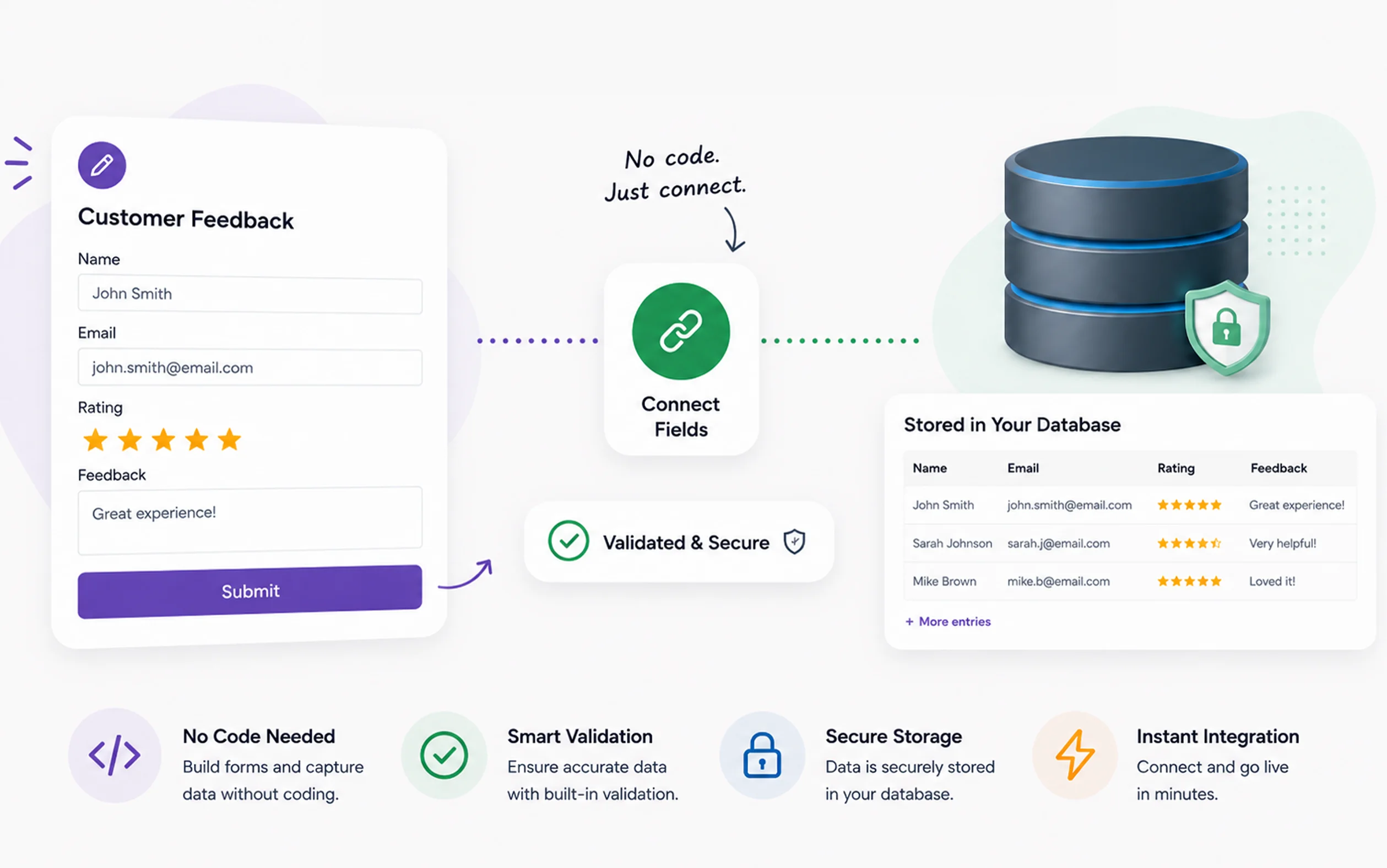
The part people tend to underestimate is how much backend work disappears once the data layer is decoupled from the interface — and how much of that disappeared work was actually the riskiest part of the original project.
Building a form that accepts user input and writes it to a database sounds trivial until you account for everything a competent backend has to do underneath it: validating input types, rejecting malformed submissions, escaping anything that could be used for injection, handling concurrent edits without overwriting someone else's changes, and logging who changed what and when. None of that is visible in the finished product, but skipping it is how internal tools quietly become the thing that corrupts your customer data six months in.
Orbitype's native form handling absorbs all of that. The AI-generated screen doesn't need to know anything about SQL injection, schema validation, or race conditions — it just needs to point its submit action at the right endpoint, and Orbitype handles the rest according to the schema you defined upfront. That's a meaningful security upgrade over a quickly hand-rolled internal tool too, since "internal only" tools are exactly the ones that tend to get the least security review, right up until someone leaves a sensitive customer field exposed on a panel nobody thought to lock down.
There's also a permissions dimension worth being deliberate about. Not everyone on your team should be able to edit every field — your support team probably needs to update order status but shouldn't be touching pricing data, and your finance team needs read access to revenue figures without write access to customer PII. Building field-level and role-level permissions from scratch is its own multi-day project in a traditional stack. With the data layer decoupled and centrally managed, it's a matter of configuring who sees and can edit what, once, at the schema level — and every interface you generate against that schema inherits the same rules automatically.
ROI Analysis

The math is straightforward once you isolate what's actually being saved: design hours and frontend engineering hours, plus the backend hours people usually forget to count.
A typical internal tool, built the traditional way, costs roughly two weeks of frontend work plus a few days of backend setup and design — call it 70 to 90 hours combined, depending on how many revision rounds the request goes through, and revision rounds are basically guaranteed once stakeholders actually start using the thing. At $75 to $100 an hour, that's $5,000 to $9,000 per tool. Most growing companies need somewhere between four and eight of these in their first two years. That's $20,000 to $70,000 of engineering spend on tools that never touch the product customers pay for.
Building it through AI generation plus Orbitype's data layer compresses that into a few hours: minutes to describe the interface, minutes to map the schema, a few more to test the connection and configure permissions. Even being conservative and budgeting half a day per tool for a real production version with permissions and automations configured, you're looking at a 90%+ reduction in both time and cost compared to the traditional build
The harder number to put a dollar figure on, but arguably more important, is what your engineering team does with the time they get back. Every internal tool that doesn't require a sprint is a sprint spent on something a customer will actually notice — a feature, a bug fix, a performance improvement. That's not a cost saving so much as it's redirected leverage, and over a year it compounds into a meaningfully faster product roadmap than a competitor who's still routing every internal request through the same backlog as everything else.
Conclusion
None of this requires betting your company on a new framework or rewriting how your engineering team works. It's a different default for one specific category of request: the internal tool nobody wants to spend a sprint on but everybody needs.
The pattern is the same every time. Describe the interface, let an AI tool generate it, point it at a schema in Orbitype, test it with a dummy entry, ship it. What used to be a two-week project with a $6,000-plus price tag becomes an afternoon's work, and the tool you end up with is just as functional — arguably more maintainable, since the data layer and the interface aren't welded together.
The teams that adopt this early aren't necessarily moving faster on their core product. They're just not getting slowed down by the dozen smaller things that used to compete for the same engineering hours. That difference doesn't show up in a single sprint. It shows up a year later, in how much of the roadmap actually got built instead of spent on dashboards nobody outside the company ever sees.





Industries
Services
Company
Resources