The Frictionless GTM Engine: Building Self-Serve Processes for Scaling Teams
Every growth team has lived this moment: a landing page needs a new headline test, a pricing tier needs to move from the footer to the hero, or a campaign launch is blocked because nobody can touch the page without a developer. The idea is ready. The data is ready. The only thing standing between the team and execution is a ticket sitting in a sprint backlog.
This isn't a tooling problem. It's a structural one. As companies scale, the volume of marketing and operational changes grows far faster than engineering capacity does — and when every change, however small, has to route through a developer, growth doesn't scale. It queues.
The fix isn't to ask engineers to move faster. It's to redesign the system so most changes never need an engineer at all.

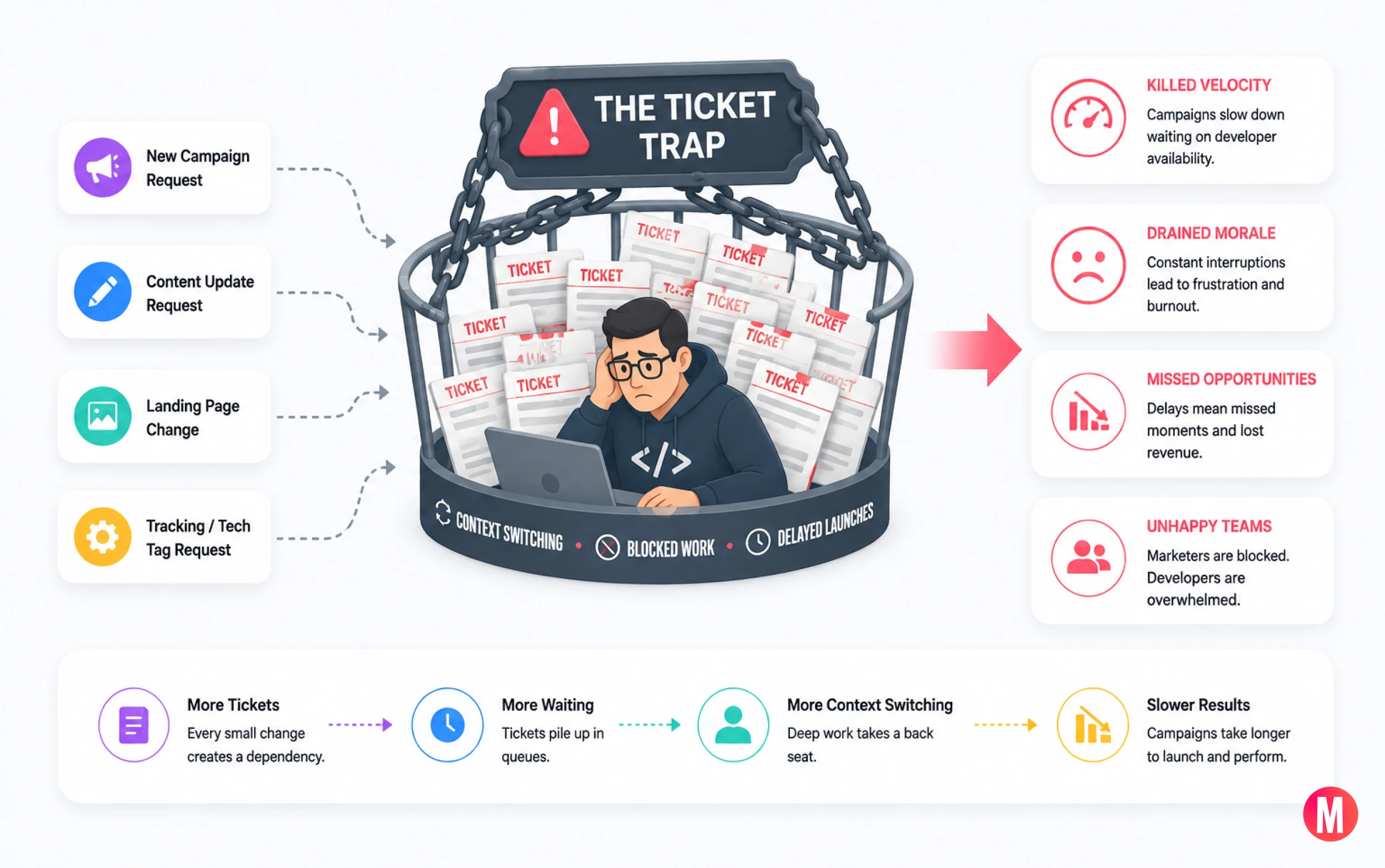
The Ticket Trap: How Developer Dependencies Kill Campaign Velocity and Drain Technical Team Morale
Picture a typical request: marketing wants to swap a CTA button's copy and color for an A/B test launching Monday. On paper, it's a five-minute change. In practice, it becomes:
A ticket filed and triaged
A wait for sprint capacity
A developer context-switching from feature work
A PR, a review, a staging deploy
A handback to marketing to confirm it looks right
What should have taken minutes takes days. Multiply that by every campaign tweak, every seasonal promotion, every pricing experiment, and the cost compounds fast.
The velocity cost is the most visible damage. Campaigns lose their window. A promotion meant to go live before a competitor's announcement ships a week late, after the moment has passed. Marketing teams start padding timelines defensively, building in buffer for delays they've learned to expect — which means the organization is now systematically slower than it needs to be, by design.
The morale cost is quieter but more corrosive. Engineers didn't join the company to swap hex codes or update copy blocks. Every ticket like this pulls a developer away from the architecture, infrastructure, or product work that actually needs their judgment. Over time, this breeds resentment on both sides: marketing feels blocked by a team that "doesn't move fast enough," and engineering feels reduced to a help desk for work that doesn't require an engineering degree to execute.
The trust cost is the most expensive of all. When growth teams can't get small changes shipped reliably, they stop proposing ambitious ones. The backlog becomes a filter that quietly suppresses experimentation — not because the ideas are bad, but because the friction to test them isn't worth it.
The instinct here is usually to add process: better ticket templates, an SLA, a dedicated "marketing engineer" role. These help at the margins, but they don't solve the underlying issue. The underlying issue is architectural: routine, repeatable changes are being treated as bespoke engineering work. Until that changes, no amount of process tuning will create real velocity.
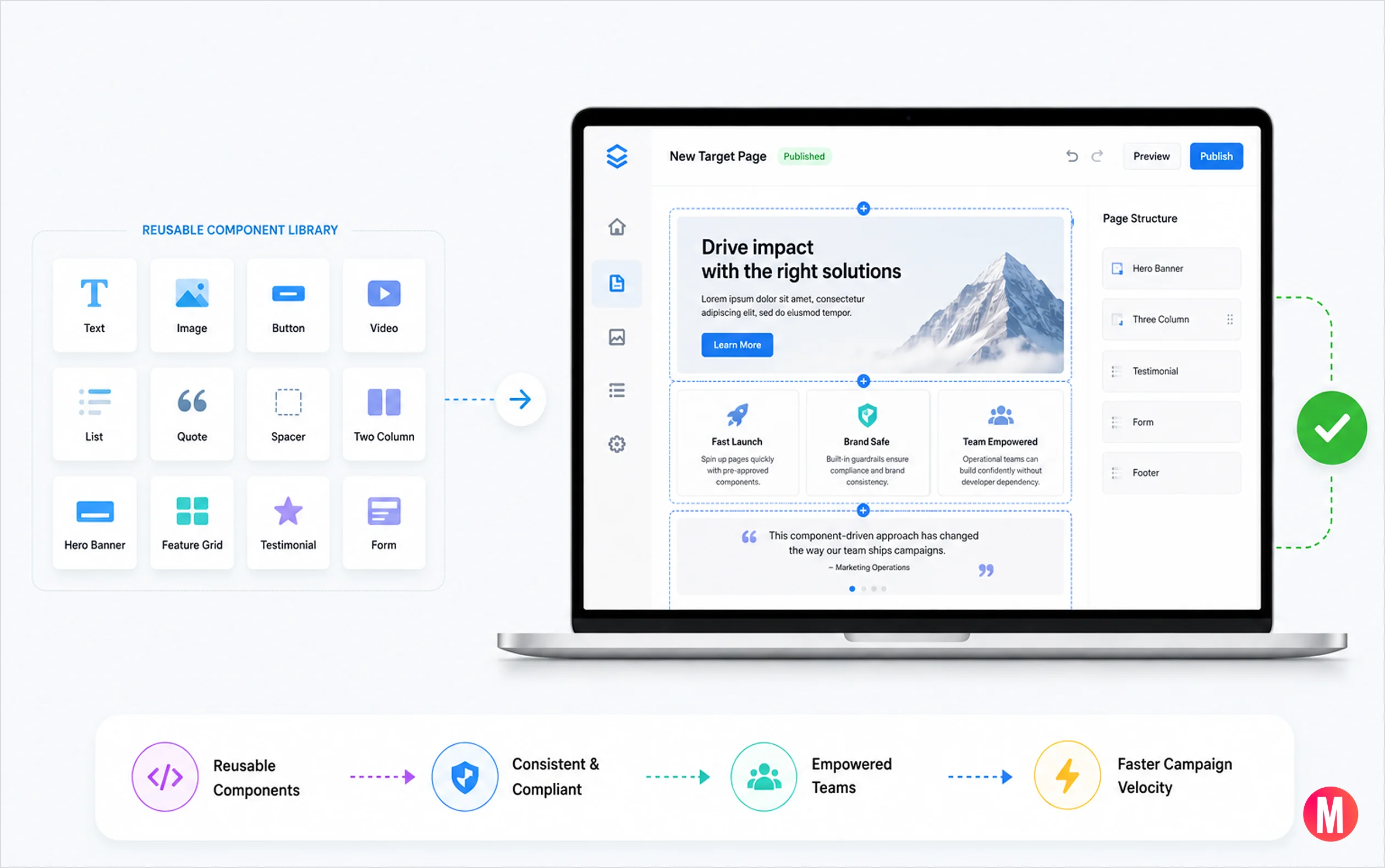
Component-Driven Workflow design: Building reusable content structures and layouts so operational teams can spin up target pages safely.
The way out of the ticket trap isn't giving non-engineers raw access to the codebase — that trades one risk for another. The way out is component-driven design: building a library of pre-engineered, reusable content blocks that operational teams can assemble, configure, and deploy themselves, within boundaries engineers have already defined.
Think of it as the difference between handing someone a blank canvas and handing them a well-stocked toolkit. A blank canvas requires expertise to use safely. A toolkit with the right pieces lets someone competent — but not a developer — build something solid without needing to understand what's happening underneath.
In practice, this means engineering teams invest upfront in things like:
Modular page sections — hero blocks, testimonial grids, pricing tables, comparison charts — each built once, tested thoroughly, and exposed as a configurable component rather than rebuilt per campaign.
Constrained input fields — instead of open-ended code access, marketers get structured fields: text, image upload, button links, color selection from an approved palette. The flexibility lives in the configuration, not the markup.
Templated page archetypes — a "product launch" template, a "webinar registration" template, a "limited-time offer" template — so spinning up a new landing page is an assembly task, not a build task.
A shared design system — components inherit brand-approved typography, spacing, and color tokens automatically, so visual consistency is enforced structurally rather than relying on someone remembering the brand guidelines.
The payoff is significant. A growth marketer can launch a new campaign landing page in an afternoon by combining existing components, rather than waiting on a sprint cycle. And because every component was engineered with edge cases, accessibility, and performance in mind from the start, the pages that get shipped are more consistent and reliable than ad hoc developer builds often are — not less.
This is the core insight of component-driven workflow design: autonomy and safety aren't in tension when the constraints are built into the tooling rather than enforced by review.
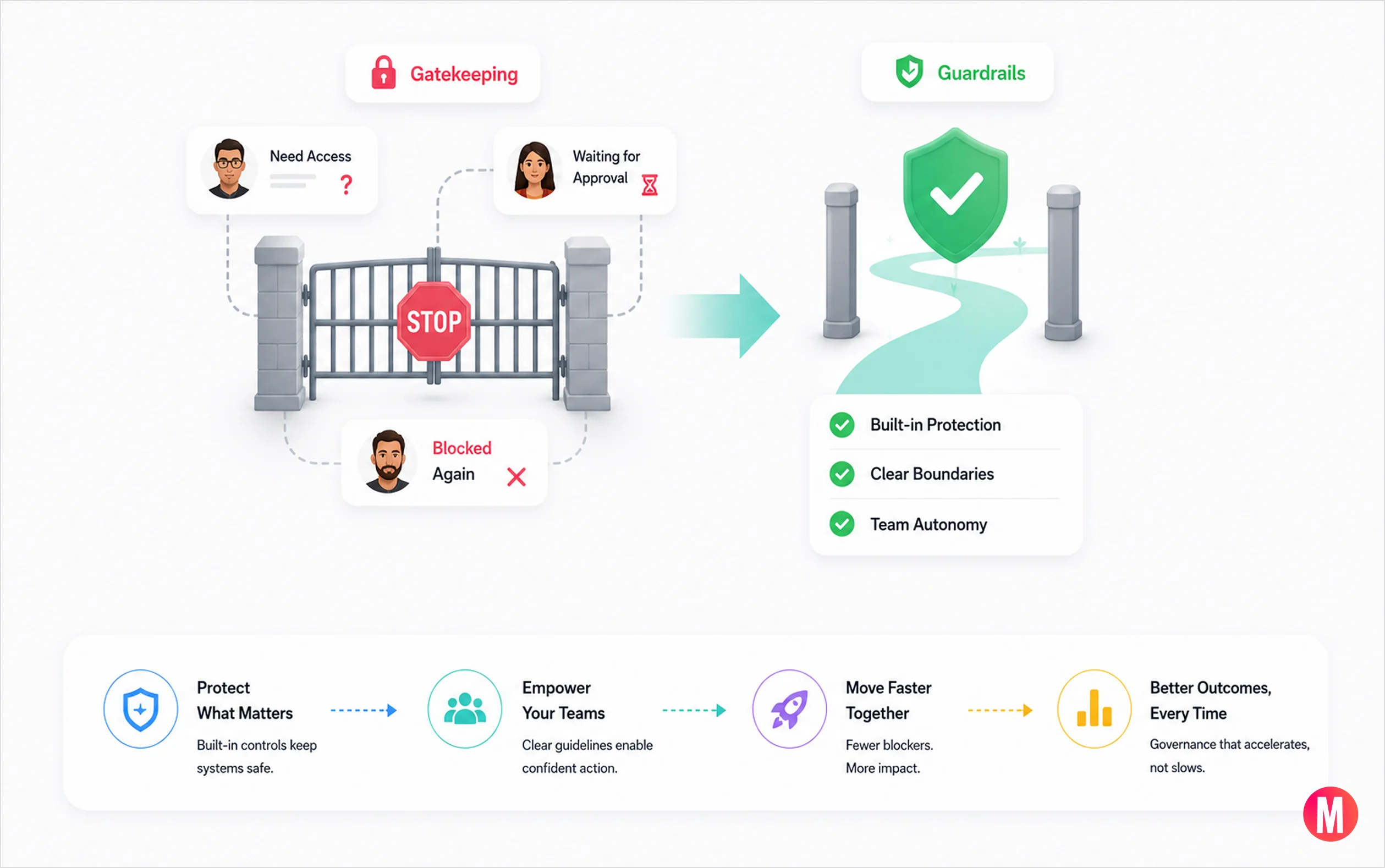
Guardrails Over Gatekeeping: Protecting Systems Without Slowing Teams Down
Self-serve tooling only works if engineering trusts it — and that trust comes from guardrails, not gatekeeping. Gatekeeping means a human has to approve every change before it ships. Guardrails mean the system itself prevents the changes that would cause harm, so approval isn't the bottleneck.
The distinction matters operationally. A gatekeeping model scales linearly with request volume — more campaigns means more review load, which means the bottleneck just moves from "engineering builds it" to "engineering reviews it." A guardrail model scales with the system, not the request volume, because the validation is automated and built once.
Effective guardrails typically operate at a few levels:
Validation rules at the input layer. Forms that won't let a marketer submit a broken link, an oversized image, or a headline that exceeds the character limit a layout can handle. The error gets caught at entry, not after the page is already live and breaking.
Staging environments as a default, not an extra step. Every change previews in a staging environment that mirrors production before it goes live — giving the person making the change a chance to catch issues visually, without requiring an engineer to be in the loop for every preview.
Permission boundaries scoped to the task. A campaign manager can edit copy, swap images, and adjust layout within a template. They cannot edit the underlying component code, alter data schemas, or touch anything that connects to backend logic. The boundary isn't "ask permission" — it's "the option to break this doesn't exist in your interface."
Data integrity checks at the structural level. If a page pulls dynamic pricing or inventory data, the system validates that data connections remain intact regardless of what cosmetic changes are made on top. The structure protects itself.
Audit trails and rollback. Every change is logged and reversible. This doesn't prevent mistakes, but it removes the fear around them — a marketer who can undo their own error in seconds doesn't need an engineer on standby in case something goes wrong.
The shift this represents is significant: engineering's role moves from reviewing every change to designing the system that makes bad changes structurally difficult. That's a better use of engineering time, and it actually produces a safer outcome, because the safety is enforced consistently by the system rather than depending on a reviewer catching every issue by hand.
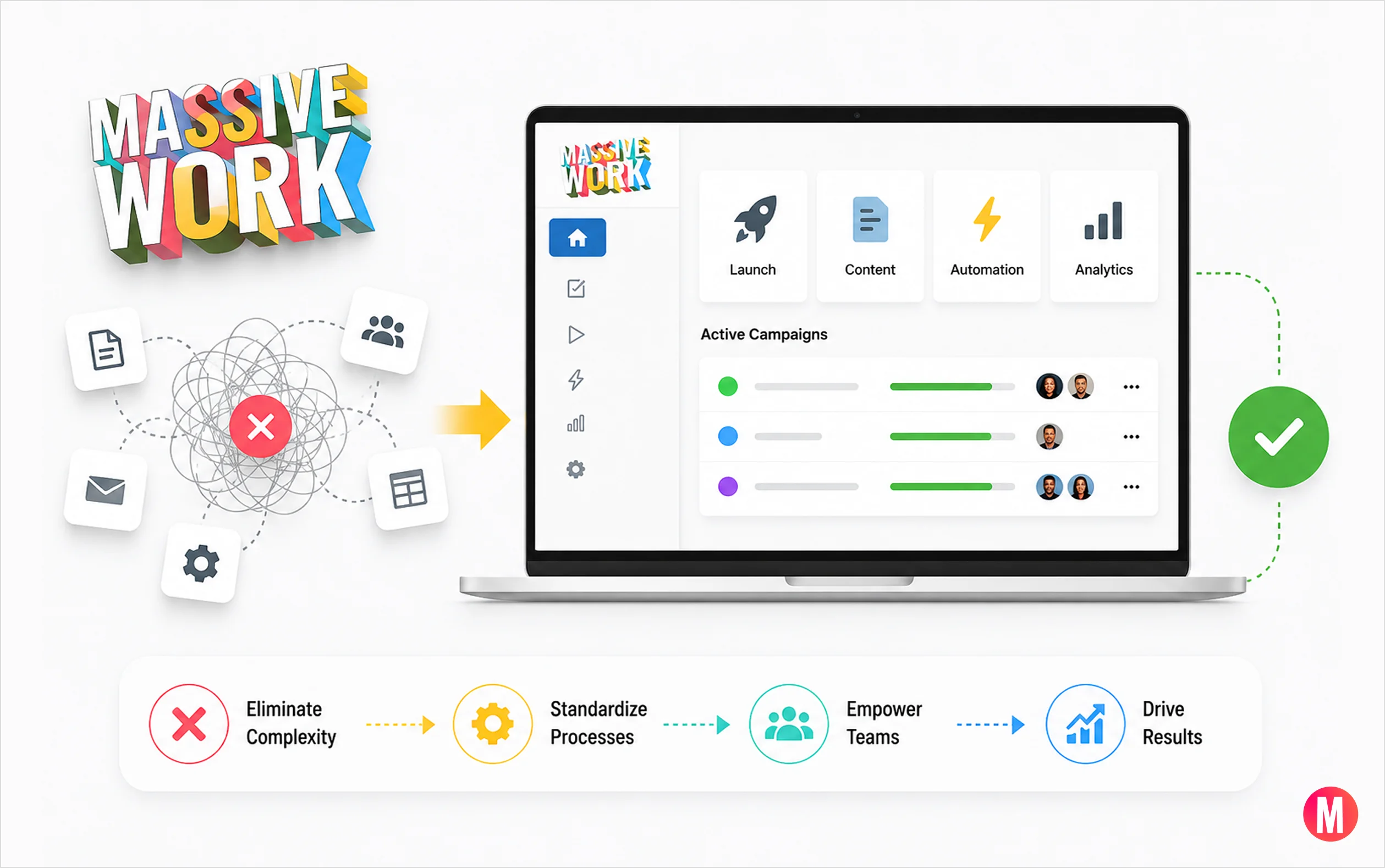
How Massivework.co Solves This
Component-driven design and strong guardrails are the right framework — but most teams don't have the bandwidth to build this infrastructure entirely from scratch alongside their actual product roadmap. This is the gap massivework.co is built to close.
massivework.co provides a secure, visual workspace that lets growth and operations teams build, edit, and launch campaign pages and structural updates directly — without filing a ticket and without touching code. Marketers work in a visual interface that feels closer to a design tool than a codebase, dragging in pre-approved components, adjusting copy and imagery, and previewing changes in real time.
What makes this workable rather than risky is that the freedom on the marketing side is paired with real control on the engineering side:
Engineers define the building blocks once. Components, templates, and data connections are built and governed by engineering, with the constraints of the component-driven approach baked in from the start.
Marketing operates within those blocks with full autonomy. No waiting on availability, no sprint planning, no context-switching cost imposed on a developer for a copy change.
Every change runs through built-in guardrails. Staging previews, validation rules, and permission scoping are part of the platform itself, not a manual process layered on top.
Engineering retains architectural oversight. Because the underlying structure is centrally managed, engineers can update a component once and have that update propagate everywhere it's used — rather than fixing the same problem across dozens of one-off pages.
The result is a genuine resolution to the tension that usually exists between speed and safety. Growth teams get to move at the pace their work actually requires. Engineering teams get to spend their time on the architecture and product logic that only they can own. Neither side is waiting on the other, and neither side is taking on risk they didn't agree to.
Final Thoughts
The ticket trap doesn't get solved by working harder inside the old system — it gets solved by changing what the system requires in the first place. Every team eventually hits the same wall: growth wants to move at the speed of ideas, and engineering needs to protect the speed of the product itself. Treating that as a tug-of-war is what creates the backlog. Treating it as a design problem is what dissolves it.
Component-driven workflows and guardrail-based permissions aren't just operational nice-to-haves — they're the mechanism that lets both teams be fully autonomous in their own domain without stepping on the other's. Marketing doesn't need to understand the codebase to move fast. Engineering doesn't need to review every campaign to stay safe. The structure does that work, continuously, without anyone having to ask.
Teams that make this shift early get a compounding advantage. Every component built once gets reused dozens of times. Every guardrail put in place removes a future review cycle. The investment isn't a one-time fix — it's infrastructure that keeps paying down friction as the team scales, long after the initial setup is done.
The companies that win the next phase of growth won't be the ones with the biggest marketing team or the biggest engineering team. They'll be the ones who removed the queue between the two — and built an engine where both can move at full speed, at the same time, without ever being in each other's way.






Industries
Services
Company
Resources